
Castlehill Walking Tour
Castlehill Attractions
Royal Mile Edinburgh
Castlehill Edinburgh is a short road that begins at the Castle Esplanade and ends at the Tolbooth Kirk. The gothic spire being the highest point in central Edinburgh constructed between 1842 and 1845, now the headquarters International Festival society. The other attractions in the street are the; Camera Obscura & World of Illusions, (One of the oldest tourist attractions in the city), Cannonball House, Its name derived from the cannonball embedded in the outside wall of the house. Witches Well, where over 300 witches were burned at the stake. The Scottish Whisky Experience, where you can see how whisky is made and try one of the many whiskies available. The Scottish Weaving Mill previously the reservoir for Edinburgh, now a retail outlet with the best selection of Scottish goods available, also see Tartan being made on the only working looms in the city.
The All About Edinburgh books are available in store the best guide to the whole of Edinburgh.
Castlehill Royal Mile Edinburgh

Witches Well
Castlehill Royal Mile Edinburgh
The site of the Witches Well is situated at the top of Castlehill on the west wall of The Tartan Weaving Mill where an iron wall fountain commemorates the place where over three hundred women were burned at the stake, accused of being witches in the 16th Century. There were more Witch burnings carried out at Castlehill than anywhere else in Europe.

Witches Well Plaque
Castlehill Royal Mile Edinburgh
This fountain, designed by John Duncan, R.S.A is near the site on which many witches were burned at the stake.
The wicked head and serene head signify that some used their exceptional knowledge for evil purposes while others were misunderstood and wished their kind nothing but good. The serpent has the dual significance of evil and wisdom.
The foxglove spray further emphasises the dual purpose of many common objects. The plaque was unveiled in 1894

Castle Wynd Royal Mile North Steps
Castle Wynd North Royal Mile Castlehill Edinburgh is a set of steps with housing on the east side that begins at Castlehill next to the Edinburgh Castle Esplanade and ends in Johnston Terrace Edinburgh. The House at the top of Castle Wynd North is Cannonball House which has survived through 3 sieges of Edinburgh Castle in 1650 by Cromwell, in 1689 by William of Orange and by the rebel Jacobite Army in 1745, when General Preston shot Cannon from the Half moon battery at the rebels a cannonball lodge in the wall and remains there to this day. At the foot of the steps directly across the road (Johnston Terrace) is Castle Wynd South steps which ends at the Grassmarket a pedestrian precinct with bars, restaurants and shops.


Edinburgh Reservoir
Tartan Weaving Mill
Castlehill Royal Mile Edinburgh
This is an opportunity to see the full story of kilt making, from the wool on the sheep via the weaving of the tartan cloth to the making of the kilt. Try out the weaving loom for yourself, or dress up in ancient Scottish costume for a souvenir photograph. The picture on the left shows the Tartan Weaving Mill from Ramsay Garden, below a sword that would have been used at the time of William Wallace. See the armoury in the Tartan Weaving Mill.

Cannonball House
Castlehill Royal Mile Edinburgh
Can you spot the cannon ball embedded in the wall. The story is that the cannon ball was carefully placed here by engineers to mark the height above sea-level of the fresh springs which provided Edinburgh with its first piped supply of fresh water, in about 1621. The cannon ball can be seen embedded in the wall above the first-floor window in Castle Wynd North. On the opposite side where the Tartan Weaving Mill is now, was the site of a reservoir that served the well heads in the old town of Edinburgh. In 1991 the reservoir was no longer required and is now conserved as the Edinburgh Tartan Weaving Mill. The original windows can still be seen. The inner sash and case being modern.


The Cannonball
The cannonball embedded in the wall can be seen from the steps that go down to Johnstone Terrace from Castlehill. Legend has it that in 1745 the castle garrison fired the cannon ball at Bonnie Prince Charlie’s encampment at Dunsapie Loch but missed and hit the house.

Patrick Geddes Heritage Trail
Castlehill Royal Mile Edinburgh
Patrick Geddes (1854 – 1932) was an Educator, Conservationist, Town Planner, Philosopher, Sociologist, Biologist, Botanist and Ecologist. Born in Ballater, Royal Deeside. The Edinburgh Patrick Geddes Heritage Trail was produced by the Sir Patrick Geddes Memorial Trust in the year 2000. You can you can find out more from the Patrick Geddes Trust.

The Scotch Whisky Experience
Castlehill School
Royal Mile Edinburgh
Castle hill Primary School opened in 1889 and is now closed as a school. The front of the school can be seen from Johnston Terrace Edinburgh. The building now houses The Scottish Whisky Experience which is entered from the Castlehill across from Ramsay Lane. The Scottish Whisky Experience tells the story of the history of whisky making, from the stills in the hills to the world wide industry of today. See possibly the world’s largest collection of Scotch whisky and the chance to taste the nectar of Scotland. The whisky experts will help you find the ideal whiskies for your individual taste in the McIntyre whisky gallery. There is also a chance to shop for the whisky you love. No driving afterwards. Tasting over 18 years of age only).


First Ragged School
Ramsay Lane Edinburgh
Ramsay Lane Castlehill was the site of the first Ragged School in Scotland. It was founded by Dr Thomas Guthrie in 1847. Ragged Schools were free education for poor and homeless children. There is a Ragged School museum in London. THE SCULPTURED BIBLE above the door of 1 Ramsay Lane is inscribed with the words. “search the scriptures” “ST JOHN V S V 39”
The Sculptured Bible
Above the Door of the
First Ragged School
The bible above the door is inscribed with the words
“search the scriptures” “ST JOHN V S V 39”


Ramsay Garden
Ramsay Lane Edinburgh
Royal Mile Edinburgh
A winding road to the mound that takes you to Princes Street or Waverley Station. With great views over the city and the historic home of Alan Ramsay the Poet. His statue can be seen on the corner of West Princes Street Gardens at the foot of the mound.
Ramsay Lodge was where Allan Ramsay the poet lived in the 1700s. Later it was developed into 16 houses for student accommodation with a magnificent view of the New Town Edinburgh. They are now private residence. The Ramsay Garden houses are a prominent feature of Edinburgh with their red ashlars and white exteriors and were first built by Alan Ramsay in 1733.
Allan Ramsay’s original Goose pie octagonal shaped house can be found in the centre looking up from Princes Street.
The Devil on the Roof
The sculpture on the roof of Ramsay Garden was one of three that were originally placed on the three main gable ends, a devil, an angel finial and a sphinx. The Devil remains.


Castlehill Royal Mile Camera Obscura
(Outlook Tower)
World of Illusion.
The Camera Obscura (Outlook Tower was one of the original tourist attractions in 1850s Edinburgh, the first attraction being the Walter Scott Monument. The Camera Obscura gives an amazing live panoramic view of the city of Edinburgh. See the people in Edinburgh walking about the streets below and pick them up in your hand. The telescopes let you view amazing rooftop views of the city. It was named the Outlook Tower in 1892. Take a walk around the outside walkway at the top of the Tower for more amazing views.


Skinner's Close Royal Mile
Castlehill Edinburgh
Skinner’s Close was the originally Built by the Incorporation of Skinner’s and Furriers and a William Brown Skinner had a house in the close. It was also the site of Fortunes tavern before moving Old Stamp Office Close then to Nicholson Square and finally to St Andrew’s Square. Fortune’s Tavern was a place for the well-heeled and gentlemen of Edinburgh. This close was demolished to make way for the present building the Camera Obscura circa 1850
Semple's Close Royal Mile
Castlehill Edinburgh
Semple’s Close was named after the owner Lords Semple of Castle Semple (SEMPILL). The mansion was originally built for Lady Semple in 1638. Lord Hugh Semple Purchase a property next door to increase the size of his present residence in 1743. A military officer, Major in the Cameronians, Commander of the Black Watch and Colonel of the Edinburgh Regiment and commanded the left wing of the Hanoverian Army at Culloden. Inscription above door of Semple’s Mansion
PRAISED BE THE LORD, MY GOD, MY STRENTH & MY REDEEMER ANNO DOM 1638.


Boswell's Court Royal Mile
Castlehill Edinburgh
Boswell Court Castlehill is the site of the famous Witchery Restaurant and Lodging. Named after Dr Boswell the owner circa 1690 and previously known as Lowthian’s Land , but it is said that the Earl of Boswell also resided here. What can be seen on a lintel over a door in the close is the inscription “O LORD IN THE IS AL MI TRAIST”


Jollie's Close Royal Mile
Castlehill Edinburgh
Jollie’s Close named after the land and building in Castlehill owned by Patrick Jollie, and later by Alexander Jollie who was a writer in 1859. Now part of the Witchery hotel apartments which is based in Boswell’s Court Castlehill.

Palace and Chapel
Mary of Guise
Castlehill Royal Mile
The first building you will walk past on the Castehill is the site where Mary of Guise had her Palace (pictured).
Mary of Guise was the daughter of Antoinette of Bourbon and Claud Count of Guise. Mary of Guise married King James V in 1538. They had a daughter born in Linlithgow Palace in 1542 and at a week old became the Queen of Scotland on her father’s death. Her name was Mary. (Mary Queen of Scots).The building was also used as the Scottish Parliament in 1990s. Marie de Guise died in June 1560. The English and French, agreed the Treaty of Edinburgh. The military forces of both withdrew from Scotland which allowed the Scottish people to govern themselves. A Scottish Parliament was formed in Edinburgh on 10 July 1560, attended by 14 Earls, 6 Bishops, 19 Lords, 21 Abbots, 22 Burgh Commissioners, and over 100 Lairds. On the 24 August the Scottish parliament passed a series of Acts that entirely destroyed the Roman Church in Scotland. The celebration of mass was made illegal and was punishable by many things including death.
Palace and Chapel
Mary of Guise
Highland Kirk The Hub
Castlehill Royal Mile
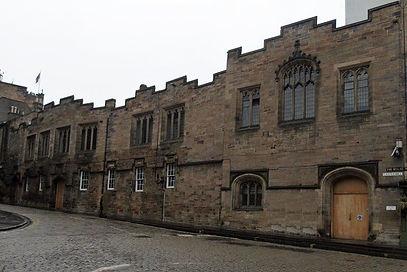
The International Festival HQ stands at the foot of Castlehill and at the top of the Lawnmarket. The Hub’s spire is the highest point in central Edinburgh. The building was constructed around 1845 as the Victoria Hall to house the General Assembly of the Church of Scotland. In 1929 the Church of Scotland ceased to use the building and it became a temporary home for a variety of congregations. It was named the Highland Tolbooth and then St John’s Church in 1956 and finally closed in the early part of the 1980s. In 1999 the building was transformed into The Hub, offices and a performance space for the Edinburgh International Festival. Sir Rudolf Bing founding Director of Edinburgh International Festival 1947 Blue Plaque at d0or.


Johnston Terrace
Johnston Terrace Edinburgh was part of the new developing Edinburgh which linked Old Edinburgh
with the new developing area of Tollcross.

St Columba's Free Church
St Columba's Free Church is a Victorian Gothic building built in 1846 for a congregation of the Old Town's poor founded by the Rev. John Alexander, a mission priest. The day school beneath the church fed and educated up to 200 boys and girls until the 1870’s

Upper Bow Royal Mile Edinburgh
The Upper Bow was part of the West Bow which was a steep road that linked the Grassmarket to Castlehill. The West Bow now ends at Victoria Street and steps take you to the Upper Bow and Victoria Terrace which is a balcony walkway that is above the old West Bow.


Lawnmarket Royal Mile Edinburgh
The Lawnmarket is the street where the linen was sold at market hence the name. As you walk down the hill from Castlehill at the midpoint of the Lawnmarket can be found on the left a well preserved 16th century townhouse called Gladstone's Land built circa 1552. Next going through a tunnel you will come across Lady Stair’s House which is where the Writer’s Museum is and crossing over the road you come to the High Court on the left with a Statue of David Hume Scottish philosopher, historian and economist outside. Directly opposite is the site where the last public hanging took place. See the plaque and cobbles. The south side of the Lawnmarket has a strong Dutch influence. Do not miss Riddle's Court and the first public library, Fisher's Court, and Brodie's Close where the notorious William (Deacon) Brodie lived.

Johnston’s Close
Johnston’s Close Lawnmarket Edinburgh is the first tenement after the west Bow on the south side of the Lawnmarket in the Royal Mile before Riddle’s Land and has no visible name. However, the Land where a tenement was built was owned by Sir Patrick Johnston Lord provost and knight of the realm in 1700 and a member of parliament for the city in 1700 to 1710. A Close would be named after the owner. Also other names connected with the first Close of the Lawnmarket are Johnston Glover and Edward Johnston junior. The close is now a private residence used for short term lets.

Riddle’s Close Riddle's Court
Riddle’s (Riddell) Close and Court was originally Built on land owned by George Riddell where the name originates from. The Fishers then sold it to Patrick Maule of the Panmure Family in turn sold it to George McMorran. Then Baillie John McMorran built a house on the land for himself in 1590. He was one of the wealthiest residents of Edinburgh at that time. Inside you can see the different interiors from the 16th – 19th centuries. The story of the building can be seen in the painted ceilings by Patrick Geddes. See where the banquet was held when King James the sixth stayed here with his Queen. It now is home to The Patrick Geddes Centre, Riddle’s Court, 322 Lawnmarket, Edinburgh EH1 2PG and the Scottish Historic Buildings Trust. Available for weddings, conferences, functions and public tours.
An inscription above the arch reads: VIVENDO DISCIMUS (living we learn)


Scottish Central Library
Scottish Central Library 312-320 Lawnmarket founded by Carnegie UK Trust in 1921 and opened in 1953 after renovations.
It was later merged with the National Library of Scotland in 1974. This was part of Fisher’s Land the building built for
Thomas Fisher a merchant and first Chamberlain of Edinburgh in 1699.


Fisher’s Close
Fisher’s Close named from Fisher’s Land owned by Thomas Fisher built a tenement on the land previously known as Hamilton’s Close which Cant’s Land was at the foot of the close Cant was the previous Land owner prior to Fisher.


Brodie’s Close
William (Deacon) Brodie (28 September 1741 – 1 October 1788), more commonly known as Deacon Brodie lived in Brodie’s Close in the Lawnmarket Edinburgh, where he also had his workshop. William Brodie was a Scottish cabinet maker and Deacon of trades (This is where the name Deacon came from). By day, William Brodie was a respectable tradesman, a Deacon and a member of the Edinburgh Town Council. When evening came he used his skills as a burglar. The money from his crimes was used to maintain his second life, including five children, two mistresses and a gambling habit. He was also a member of the Edinburgh Cape Club founded in the 1700s. The main meeting place was the Isle of Man Arms in Craig’s Close in the Old Town of Edinburgh. A meeting place for the wealthy and nobility where all manner of frivolities would take place. When Deacon Brodie was eventually caught for trying to rob the Royal Mint, he was arrested and sentenced to hang. In 1788 he was taken to the Edinburgh Tolbooth (jail) and hanged by the neck. The Tolbooth is no longer there but is marked with brass cobbles and the Heart of Midlothian. Deacon Brodie’s life inspired Robert Louis Stevenson to write the strange case of Dr Jekyll and Mr Hyde. William Brodie designed and erected the gallows in the High Street and was also the first to hang on them. The Gallows are marked with a plaque and cobbles at the corner of George IV Bridge across from David Hume’s Statue. Deacon Brodie’s Grave is in the Apse Church in Chapel Street.

Buchanan’s Close
Buchanan’s Close named from Buchanan’s Land, previously a tenement of the Abbot of Cambuskenneth which burned down in the fire of 1725. Also could have been Walter Willie’s Close. Now a restaurant entrance for the Hotel on George IV Bridge.
Take a walk back up to the Hub cross the road to Milne's Close and Court


Mylne’s Close and Court
Milne’s (Mylne’s) Court Was the first open court of its type in Edinburgh, it was built in 1692 by Robert Milne master mason to the King. The buildings were renovated in 1914. The plaque at the entry to Milne’s Court reads; one of the first open squares in old Edinburgh was designed and built by Robert Milne in the late 17th century. The old building which formed the west side of the court was demolished in 1883. The north and south blocks were restored and the east range rebuilt by the university of Edinburgh between 1966 –1970. This was made possible by generous friends of the university.


James's Court
James’s Court 493 -495 Lawnmarket Edinburgh Named after the builder James Brownhill. James’s Court was built around 1725. The philosopher David Hume and James Boswell the lawyer and author lived here. The court was destroyed by fire and re-built in 1857. There are three entry’s to the Court the West Entry where Sir John Lauder (Lord Fountainhall lived, The East Entry which was previously named Jardine’s Close after George Jardine who live here and Mid Entry the main entrance to the Court where John Dickson of Hartree lived.


James Court is a large area and has a stain Glass window worth seeing and a sculpture of a pigeon in a basket. James Court is also connected to Makars’ Court and the Writers’ Museum. Inscription on Lintel above stain glass window reads Stain Glass Window James Court Lawnmarket Royal Mile Edinburgh NISI DOMINUS FRUSTRA (ONLY THE LORD IN VAIN), with date 1860 and initials FC PH which stands for Free Church Presbytery Hall. The images in the glass are of, centre, King James VI, with Sir David Lindsay of the Mount and George Buchanan to his right and left. This window is part of the College and Offices of the Free Church of Scotland in North Bank Street Edinburgh.


Gladstane’s Land
Gladstone’s Land Lawnmarket Edinburgh is on the north side of the Lawnmarket section of the Royal Mile. Visit a building of the 16th century and experience what life was like in the Old Town by visiting Gladstone’s Land. Purchased in 1631 by a Thomas Gladstane from Sir Robert Bannatyne and left to his son William Gladstane surgeon to Colonel Lauder’s regiment.
This is a restored tenement building to show the conditions people lived in, in Edinburgh in the 17th Century.


Robert Burns
First Visit to Edinburgh
Robert Burns lived in a boarding house at the invitation by Dr Blacklock he rented a shared room with another gentleman in the house of Mrs Carfrae on arrival in Edinburgh, the actual close Robert Burns Lived in was Upper Baxter’s Close, Living in a shared room, dining and drinking with the elite of Edinburgh society. The close has not survived (knocked down when Bank Street was built in 1798). The Plaque above Lady Stair’s Close entrance reads;
In a house on the east side of the close Robert Burns lived during his first visit to Edinburgh 1786.
453 – 463 Lawnmarket
Lawnmarket 453 – 463 was built in 1892 5 storeys to front with shops below and 6 to back was part of Geddes’s idea of restoration through modernisation of Lady Stairs and Wardrop’s Court. The 3 sculptured panels of heads.

Arts
(artists and potters tools)

Crafts
(tradesmen's tools)

Academia
(books and sports equipment).

Lady Stair's House
The Writers' Museum is housed in Lady Stair’s House which was built in 1622. This was originally called Lady Gray’s Close the widow of Lord William Gray of Pittendrum (Egidia (Smith) Grey) who was the wealthiest merchant of his time.
After his death (1648) the house was later sold on 7th April 1719 to Elizabeth, Countess-Dowager of Stair widow of John Stair 1st Earl of Stair and the house was renamed Lady Stair’s House. The House was purchased in 1895 by the Earl of Roseberry and he had it restored in 1897. In 1907 gifted it to the City for use as a municipal museum.
Wall inscription: Feare the Lord and depart from Evill 1622


Lady Stair’s Close
BLISSIT BE THE LORD IN HIS GIFTIS.
The modern metal plaque reads 'Lawnmarket Housing Action Area 1988-91. Restored with Grants from the Secretary of State for Scotland and the City of Edinburgh District Council. Edinburgh Old Town Committee for Conservation and Renewal


Writers' Museum
The Writer’s Museum is dedicated to the lives and work of Scotland's great literary figures. Rare collections include early editions, manuscripts, portraits, photographs, and personal belongings of Robert Burns, Sir Walter Scott and Robert Louis Stevenson. Entry is Free.


The Writers' Museum is on two floors with rooms dedicated to each of the famous authors, writers, poets. On the main floor on entry there is busts of the three Robert Burns, Robert Louis Stevenson and Sir Walter Scott. There is a replica of the Scott Monument and many documents, pictures, books and personal items of the three.

Robert Burns was born in Ayrshire on the 25 January 1759 and died in Dumfries on the 21 July 1796 where he is buried in the church close to where he lived.
Sir Walter Scott was born in Edinburgh on the 15 August 1771 and died on the 21 September 1832 and is buried in Dryburgh Abbey near his home Abbotsford in the Scottish Borders.
Robert Louis Stevenson was born in Edinburgh on the 13 November 1850 and died on 3 December 1894 and buried on
Mount Vaea, Upolu, Western Samoa.
Makars’ Court
The Makars are the award winning writers / Poets of Scotland. There are 39 Slabs that have the Makars’ names inscribed one slab for each person. Below is a link to the Makars’ the slabs and who they are / were. A Makar is a poet or author a person skilled in the art of writing.
Robert Burns 1759 – 1796 MAN TO MAN THE WORLD O’ER
SHALL BRITHERS BE FOR A’ THAT

Robert Fergusson 1750 – 1774
AULD REIKIE WALE O’ I LKA TOWN

Sir Walter Scott 1771-1832
THIS IS MY OWN, MY NATIVE LAND


Wardrop’s Court
Lawnmarket Wardrop’s Court Royal Mile Edinburgh is the last court before crossing Bank Street to the final building in the Lawnmarket, Edinburgh High Court. Wardrop’s Court was previously Middle Baxter’s Close and the John Wardrop built a tenement in the court and called it Wardrop’s Court with the entrance archway Wardrop’s Close. The entrance is noticeable by the Dragons on each corner. The Dragons were sculpted by J S Gibson circa 1890.

Wardrop’s Court Lawnmarket
Blue Dragons
The plaque on the right hand side of the court entrance reads; the pair of dragons facing the Lawnmarket were carved by
J S Gibson in the 1890s. The pair at the rear were carved in 1911 by Arthur Geddes when he was 16 under the supervision of Alec Miller, a craftsman closely associated with the arts and crafts movement. Arthur was the son of Patrick Geddes, the influential biologist and town Planner who dedicated much of this life to the regeneration of the Old Town. The dragons were restored in 2012 by the City of Edinburgh Council and Edinburgh World Heritage, with support from the Brownlee Old Town Trust and the Geddes family.


Blackie House
Blackie House Lawnmarket Wardrop’s Court Edinburgh was named after the resident James Stuart Blackie. The ornate window surrounds of his house can be seen in North bank Street on the second floor. Look up above the shops on North Bank Street to see the window with the memorial to James Blackie a University of Edinburgh Professor in Greek and German. He left 250, 19th century Greek books to the University Library which are still being used by students today. He was born in Aberdeen and studied in Germany and Italy. He was the inspiration behind the founding of the Celtic chair of the University of Edinburgh.


News Steps St Giles Street
The News Steps are next to The Bank of Scotland Building at the end of St Giles Street across from West Parliament Square in the High Street Royal Mile Edinburgh. The steps will take you to the Waverley Bridge and the train Station.
On the railings you will find hundreds of padlocks
THE BANK MUSEUM
BANK STREET EDINBURGH
Opened in 2006 telling the story of money. Art & design, technology, crime, trade and security all feature in the story of money. Come in and see for yourself what 1 million pounds looks like. The Bank of Scotland is the second longest surviving bank in the United Kingdom and was established just 1 year after the Bank of England in 1695 by a Scotsman, William Paterson. The Bank of Scotland was founded by John Holland an Englishman.

Dr Robert Philip
Bank Street Edinburgh
The worlds’ first tuberculosis dispensary was opened in Bank Street Edinburgh by Dr Robert Philip in 1887.
Sir (Dr) (Professor) Robert Philip pioneered the management, prevention, detection and treatment of tuberculosis (TB). On the wall in Bank Street a blue Plaque reads "Near this place in 1887, Dr Robert Philip founded a tuberculosis dispensary, the first clinic in the world dedicated to fighting a disease of which he foretold Man's eventual mastery.
That vision has brought hope to many lands." Tuberculosis (TB) was the biggest killer in the UK by the middle of the 19th century and due to Sir Robert Philip it has been almost eradicated. Sir Robert Philip died at home in 9 Palmerston Road, in the Grange area of Edinburgh, on the 25th January 1939.

David Hume Statue
David Hume was born on the 26 April 1711 in Edinburgh, he was a Scottish philosopher and historian. He was one of the most important figures in the history of Western philosophy and the Scottish Enlightenment. David Hume attended the University of Edinburgh. Hume achieved great literary fame as a historian when publishing, "The History of England".
David Hume lived from 1771 until his death in 1776 at his home in St. Andrew Square in Edinburgh's New Town.
The actual site of his home was 21 St David Street. There are two thoughts on how St David’s Street was named firstly after King David I son of Malcolm III and the other after David Hume. David Hume wrote many books including,


Lawnmarket Wellhead
The Lawnmarket Wellhead can be found up from St Giles Cathedral at the junction of the Lawnmarket and the High Street. This is where the residents of the Lawnmarket would collect their fresh drinking water every day. The water was piped from the reservoir at Castlehill to cisterns / wellheads to give the people fresh water.


Lawnmarket Gallows Last Public Execution Plaque and Cobbles
The brass plaque on the Wall of the Lothian Chambers Building and brass cobbles at the side of the walkway show the place where the gallows stood and the site of the last man to hang in public in Edinburgh. The site of the gallows is marked by the three brass plates set at the edge of the pavement. The first public execution from the same gallows was on 1 October 1788, a William (Deacon) Brodie. The gallows William (Deacon) Brodie had designed and funded and built the year before. The inscription on the brass plaque reads; Site of the Last Public Execution in Edinburgh. The site of the gallows is marked by the three brass plates set at the edge of the pavement in front of this notice. George Bryce, the Ratho Murderer, was executed here on 21st June 1864, the Last public execution in Edinburgh.


Burns Tavern by George Cattermole
Burns Tavern previously Dowie’s Tavern in Libberton's Wynd ran from the Lawnmarket to the Cowgate on the eastern side of the George IV Bridge. Libberton’s Wynd was knocked down with the building of George IV Bridge in 1834.
Johnnie Dowie was the owner of Dowie’s Tavern until his death in 1817. The new owner changed the name to Burns Tavern a favourite Howff of Robert Burns when he lived across the road in 1786. Also many other notable gents of the time frequented the Tavern. They included Henry Raeburn, Robert Fergusson and Thomas Campbell, David Hume, Christopher North,
David Herd and Archibald Younger all now famous names of Edinburgh.


George IV Bridge Area
The bridge that spanned the Cowgate was to be named after George IV. The bridge was completed in 1832 as part of the Improvement Act of 1827. George IV Bridge was built to connect the South Side district of Edinburgh to the New Town. The foundation stone was laid in August 1827 and the bridge finally opened to all in 1836.
There are only two points visible showing the height of George IV Bridge over the Cowgate and at Merchant Street.
It starts at the Royal Mile Lawnmarket and continues to Bristo Place and Forrest Road. Also Chamber Street where the National Museum of Scotland is and on the Bridge stands the National Library of Scotland.
County Building
Midlothian County Council offices on George IV Bridge, was built in 1904. It became the Lothian Chambers in 1975. Following local government reorganization, it became the Lothian Regional Council Chambers. While the new Scottish Parliament building was under construction, the chambers were used for administration and meetings for parliament from 1999 -2004. It was then used as the Edinburgh Registrar’s Office As a venue for weddings and civil partnerships till 2018 when it became the French Consulate-General and the French Institute for Scotland.
A great place for lunch and dinner in their Bistro / Brassiere.

Melbourne Place
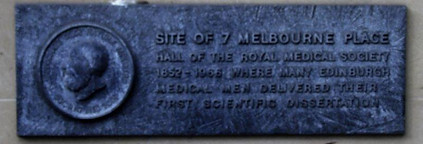
Melbourne Place was demolished in 1966 to enable the council to build an office block for their own use. The halls were first opened in 1852 however the Royal Medical Society was founded in 1737 and gained the royal charter in 1778. This Plaque marks the site of the Hall of the Royal Medical Society from 1852 - 1965 where many Edinburgh medical men delivered their first dissertation. It was demolished by the city council to enable them to build an office block which has been changed into a hotel.
Victoria Terrace an Victoria Street (India Buildings)
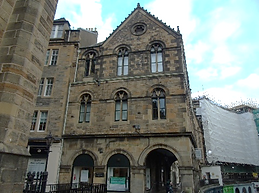
Victoria Street created circa 1835 is a continuation of the West Bow. The West Bow previously before George IV Bridge was built a Z shape narrow Wynd that connected the Grassmarket with Castlehill and the Lawnmarket. Now there are steps on the north side that connect to Victoria Terrace and the Upper Bow, Castlehill and the Royal Mile.


The building with arches on Victoria Terrace was built in 1866 as the United Original Secession Church it closed in 1900 and and later in 1988 became the Quaker Meeting house. On the south side of the Street is India Buildings built 1866. 1-6 Victoria Street, was occupied by the British Linen Bank, the Scottish Chamber of Agriculture, and the Geological Survey of Scotland. In 2022 the Vigin Hotel opened, on construction there were many medieval artifacts, ruins of previous buildings found dating to the 10th century. Inscription 'Dominus Providebit.' The Lord Will Provide


National Library of Scotland
George IV Bridge Edinburgh
The National Library of Scotland building was completed in 1956. The Library was given the legal right under the 1710 Copyright Act to claim a copy of every book published in Britain. Due to the volume of books and manuscripts a second building opened in Causewayside in 1995. The National Library of Scotland is one of the largest of Europe's research libraries with almost 20 million printed items in the collection. If you wish to find out about almost anything you will find it in there.

Highland and Agricultural Museum
The Museum was built in 1840 but only opened to public in 1975 and transferred to Ingliston in 1982 and is now in East Kilbride. The statue above the door is; the centre Caledonia and to the left and right are the ploughboy and Highland reaper with his scythe. The scene below Caledonia is a shepherd with a sheep at his feet standing between a cow and horse and a dog sitting. The inscription below: SEMPER ARMIS NUNC ET INDUSTRIA | EVER ARMS AND NOW INDUSTRY.


Central Library George IV Bridge Edinburgh
Central Library was opened in 1890 and was the first public library building in Edinburgh.
The Central Library was funded by Andrew Carnegie. However the first recording of a library in Edinburgh was in 1696 in High School Yards with 120 books and a further donation of 200 books by T Kincaid in 1709.


Bridges over Cowgate and Market Street
George IV Bridge was built to give access to Edinburgh’s Southside and spans the gap that joins the Lawnmarket on the Royal Mile with Chamber Street in the south. The foundation stone was laid in August 1827 and the bridge finally opened to all in 1836. There are only two points visible showing the height of George IV Bridge over the Cowgate and at Merchant Street. The Bridge was named after King George the IV after his visit to Edinburgh in 1822. The visible bridge over Merchant Street and a view of Greyfriars Graveyard view down Cowgate towards Holyrood Palace and Arthur Seat.


The Elephant House (Harry Potter)
J K Rowling is most famous as the creator of the Harry Potter stories. She wrote the first part of Harry Potter in the Elephant House Café on George IV Bridge, Edinburgh. George Heriot’s School in Lauriston Place is said to be the famous Hogwarts College of Magic portrayed in the Harry Potter movies and the platform in the Waverley Station is where the Train left for Hogwarts.

The inscription on the plaque reads;
Made famous as the place of inspiration to writers such as J.K. Rowling who sat writing much of her early novels in the back room overlooking Edinburgh Castle. Ian Rankin author of Rebus novels and Alexander McCall- Smith have both also frequented The Elephant House as well as many other writers.

Augustine Congregational Church
The first church building North College Street Chapel opened 1802 then renamed Argyle Square Chapel 1840, both of which are now in Chamber Street the Church is in George IV Bridge.
Bristo Place church built as a replacement for a chapel which was demolished circa 1855 to make way for the
Phrenological Museum in Chambers Street now the Anatomy Museum Teviot Place.
After construction of the new George IV Bridge (1832), Augustine was opened in 1861

Martyr's Free Church 26 George IV Bridge
The building was constructed in 1859 for the Reformed Presbyterian congregation and was initially named Martyr's Free Church for the Reformed Presbyterian Congregation. De-consecrated as a church in 1999 and opened in 2000 as a pub.

Greyfriars Bobby Statue
Greyfriars Bobby was a Skye terrier who became known in 19th-century Edinburgh after spending 14 years guarding the grave of his owner, John Gray. Bobby himself died in 1872. A year later a statue was erected at the top of Candlemakers’ Row across from the Greyfriars Kirkyard. There is also a red granite headstone in Greyfriars kirkyard near the gate. Have a stroll around the Greyfriars Kirkyard and see many famous and powerful people of old Edinburgh. Greyfriars Bobby died 14th January 1872 age 16 years. Let his loyalty and devotion be a lesson to us all.

Greyfriars Bobby Plaque
The Plaque underneath the statue of the dog reads; a tribute to the affectionate fidelity of Greyfriars Bobby in 1858 this faithful dog followed the remains of his master to Greyfriars Kirkyard and lingered near the spot until his death in 1872.
With permission erected by the Baroness Burdett Coutts.

Candlemakers' Row
Candlemakers' Row was once the main thoroughfare from the Grassmarket out of Edinburgh linking with Jamaica Street (now Chamber Street) which ended at Blackfriars Abbey (foot of Infirmary Street). Candlemakers' Row winds up from the Grassmarket at Cowgatehead to Greyfriars Place at George IV Bridge and Chamber Street where the Scottish National Museum Stands. At the top of Candlemakers' Row is where the statue of Greyfriars Bobby can be found an icon of the City of Edinburgh. A small street of to the east halfway up Candlemakers' Row (Merchant Street) has restaurants, pubs and accommodation and the George IV Bridge can be sent stretching over the street. This street is a dead end. On the west side of Candlemakers' Row stands Greyfriars Graveyard, where many famous Edinburgh people are buried where Ghostly goings on with haunted graves and unexplained noises.

Candlemakers’ Hall
The Ancient Corporation of Candlemakers' Hall stood close to the Greyfriars gates on the west side of Candlemakers’ Row. This is where the street name originated. The Candlemakers' Hall was built in 1722 and still can be seen today. The Row was where all the Candlemakers’ of Edinburgh would make candles and the smell was on occasion so strong that residents of Candlemakers’ Row tried to stop the trade.
The Wall Tablet is weathered it had 1722 and the coat of Arms of the
Incorporation of Candlemakers and above the motto
OMNIA MANIFESTA LUCE (All In Clear Light)


Greyfriars Kirk + Greyfriars Museum
Greyfriars Kirk takes its name from the Franciscan friary which was previously on this site. Greyfriars Kirk building was completed in 1620 the first church to be constructed in Scotland following the Reformation. The signing of the National Covenant took place in Greyfriars Kirk on 28 February 1638. In a field nearby, in the 18th century 1200 Covenanters were imprisoned. A section of this field was incorporated into the churchyard as vaulted tombs and the area became known as the Covenanters' Prison. You will see enclosed vaults and metal fenced cages called mort safes as a deterrent to grave robbers taking the bodies from their resting place to use in the medical school for autopsy and scientific experiments. The famous grave robbers of the time were (Burke and Hare). Greyfriars Cemetery is said to be haunted by the ghost of 'Bloody' George Mackenzie who was buried here in 1691. His Spirit is said to cause bruising, bites and cuts on those who come into contact with the spirit or touch his tomb. Some visitors have reported feeling strange sensations. Take the ghost tour and find out for yourself. Don’t miss visiting Greyfriars Museum for the history and mystery of the graveyard and Kirk.

