
North Street St Andrews
North Street St Andrews
North Street runs from the City Road to
The Pends at the Cathedral.
North Street is a main thoroughfare of St Andrews
and is where you can find many attractions including
North Street
St Andrews Attractions
St Andrews War Memorial
Gregory Lane opposite
North Street St Andrews
St Andrews War Memorial
A Celtic cross with Sword of Sacrifice on the shaft, on a stepped base.
With inscription on the shaft,
PRO PATRIA 1914-1918, 1939-1945,
TO THE GLORY OF GOD AND
THE HONOURED MEMORY
OF THE MEN OF ST ANDREWS
WHO WITH COURAGE AND FAITH
AT THEIR COUNTRY'S CALL
LAID DOWN THEIR LIVES
THAT WE WHO REMAIN
MIGHT LIVE
IN FREEDOM AND PEACE
A Semi-circular wall to rear with bronze panels inscribed with names of 185 men who fell in WWI.
The Statue was unveiled on the
23rd of September 1922
Attended by
Field Marshal, Earl, Douglas Haig,
KT, GCB, OM, GCVO, KCIE


North Street
St Andrews Attractions
St Andrews Heritage Museum & Garden
St Andrews Heritage Museum and Garden
located at 12 North Street
in a 17th century house with garden.
The Museum and Garden is one of the oldest
houses in the old town of St Andrews.
The museum is all about St Andrews the people and their lives from the 1700s Our Garden is a hidden gem and, as well as a sensory garden and a variety of plants, visitors can enjoy exhibitions and installations throughout. Our dedicated an enthusiastic museum guides look forward to sharing the rich heritage of St Andrews.
North Street
St Andrews Attractions
Jock Hutchison Plaque
Jock Hutchison was born in St Andrews
06 June 1884 (John Waters Hutchison).
He became a professional golfer
and won the Open Championship at
St Andrews over 36 holes by 9 strokes in 1921.
The previous year he won the
PGA Championship.
He die, aged 93 in 1977.
He won the inaugural PGA Seniors'
Championship in 1937 and inductee of
the World Golf Hall of Fame in 2011


North Street
St Andrews Attractions
Fitzroy Barometer
Admiral Robert Fitzroy (5 July 1805 – 30 April 1865)
Admiral Fitzroy was a famous meteorologist
who made accurate weather forecasting a reality.
He was Governor of New Zealand in 1843 till 1845.
He was also the captain of HMS Beagle and invited
Charles Darwin to be a scientific passenger
on the voyage which lasted 5 years.
This was to give Darwin his inspiration for
‘The Theory of Evolution’.
North Street
St Andrews Attractions
Benjamin Franklin Plaque
Honours bestowed upon Benjamin Franklin by
St Andrews Scotland.
The Plaque reads; "Benjamin Franklin.
In 1759 the University of St. Andrews awarded an honorary doctor of laws degree to Benjamin Franklin and
the city of St. Andrews granted him the freedom of the Burgh.
This marker commemorates the conferring of these honours.
Marked places by the National Society Daughters of the American Revolution October 2002"


North Street
St Andrews Attractions
College Gate
College Gate is entrance to
St Andrews University Buildings
North Street
St Andrews Attractions
Younger Hall St Andrews
Younger Hall is the main venue for
St Andrews University graduation ceremonies.
James and Annie Younger, local philanthropists
donated funds for the building which was opened in 1929 by HM Queen Elizabeth the Queen Mother


North Street
St Andrews Attractions
James Crichton's House
19 August 1560 – 3 July 1582
James Crichton was a most gifted individual,
educated at St Andrews University
completing the requirements for both
his bachelor's and master's degrees
by the age of 14.
He became fluent in multiple languages
and was accomplished in many of the arts
and a master swordsman.
His tutor was the scholar,
politician and poet George Buchanan.
James was a gifted prodigy,
with a gift of perfect recall.
He travelled to France then Italy
where he eventually met his death
by Vincenzo Gonzaga the son of
the Duke of Mantua
whom James was employed.
At the age of 21. Known as
"The Admirable Crichton"
referred to by Charles Dickens.
Many books have been written about him
as he was admired by many.
He has a society named after him,
at St Andrews University,
The James Crichton Society.
North Street
St Andrews Attractions
Józef Kosacki Plaque
Józef Stanislaw Kosacki
(21 April 1909–26 April 1990)
was a Polish professor, engineer, inventor,
and an officer in the Polish Army during
World War II, stationed in St Andrews Scotland.
He invented the Polish Mine Detector.
The Ardgowan Hotel was the HQ
of the Polish army during the the world war.

St Salvator's Quad
North Street St Andrews
University of St Andrews
Originally St Andrews University circa 1550
was made up from three colleges.
St Mary’s (1538)
St Salvator’s (1450) and St Leonard’s (1512).
In 1747 two colleges amalgamated.
Forming the United College of
St Salvator’s and St Leonard.
St Salvator’s College being chosen as the
home for the New United College.


St Salvator's Clock Tower
North Street St Andrews
The tower which has a clock was built as a copy
of Rules Tower in the Cathedral grounds
with a flat roof.
This was used circa 1545 as a gun emplacement
to ward of potential invaders.
The spire was added to the tower at a later date.
The 2 images show the tower from the street and inside the quadrant.
St Salvator's
Clock Tower Plaque
The St Salvator's clock and dials originally installed in 1853 by James Ritchie & Sons Clockmakers.
Restored in 1999.


St Salvator's Chapel
St Salvator’s Chapel was founded in 1450 by Bishop James Kennedy as a College of the Holy Saviour. The main entrance to the chapel faces out onto North Street and not into the college courtyard. The Chapel had a dual role for both the college chapel and as a collegiate church for the community of St Andrews.
St Salvator's Chapel
Bishop Kennedy
Bishop Kennedy decided to have his tomb constructed in his chapel. Between the consecration of the church and his death in 1465. In the recess is a large slab of black marble. Beneath is the tomb-chest in which Kennedy was interred.
Provost Hugh Spens
Set against the west wall of the chapel is the tombstone of Provost Hugh Spens who died in 1534.
The memorial bears the only known illustration of the Scottish mediaeval academic garb of the period.

St Salvator's Chapel
Bishop Kennedy Coat of Arms
James Kennedy was son of King Robert III daughter Mary.
He was born 1408. He replace Bishop Wardlaw in 1440 being appointed by Pope Eugenius IV as Bishop of St Andrews. He was in 1444 appointed Chancellor of Scotland. He died in 1465 and place in his tomb in
St Salvator’s Chapel
The Ghostly Face of Hamilton
Look up above the gateway
You will see a face carved in a stone
This is said to be the face of
The Martyred Patrick Hamilton.

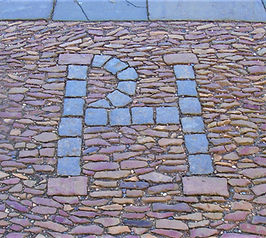
Patrick Hamilton Cobbles (PH)
The cobbles beneath the bell tower have the initials 'PH' set in to the cobbles, which marks the site of where
24-year-old Patrick Hamilton died in 1528, after being burnt at the stake for his Protestant beliefs.

Patrick Hamilton Plaque
The initials on the pavement nearby mark the spot where Patrick Hamilton member of the University was burned at the stake on 29th February 1528 at the age of 24.
On the continent he had been greatly influenced by Martin Luther, and on his return to St Andrews he began to teach Lutheran Doctrines. Having been tried and found guilty of heresy he was condemned to death. Thus becoming the first martyr of the Scottish Reformation.
St Salvator's Quadrangle
The United College of St Salvator’s and St Leonard, is one of the oldest remaining parts of the University of St Andrews.
St Andrews University had extended to three colleges.
St Salvator’s (1450), St Leonard’s (1512) and St Mary’s (1538).
In 1747, the union of the two Arts colleges formed the United College of St Salvator and St Leonard.
St Salvator’s College was chosen as the home for the new United College, the majority of the current buildings date from the 19th and early 20th century.


St Salvator's Quadrangle
Lower Hall

St Salvator’s Quadrangle
Flagstones of Alumni and Friends
One of St Andrews University’s 600th anniversary fundraising initiative was Flagstones were Alumni and Friends of the University were offered opportunity to have their names engraved on the new flagstones to be placed in the Quadrangle. This was a great success with Alumni from all around the world responding, with memories from their years studying at the University of St Andrews. Lower College Halls
St Salvator's Quadrangle
St Salvator's Chapel Cloisters

St Salvator's Quadrangle
St Salvator's Chapel,
Clock Tower and Cloisters
