
Leith Attractions
Leith Central Station
Leith Central Train Station by North British Railway, was the largest new railway station built in Britain in the 20th century.
The Station opened in July 1st 1903 as a terminus for suburban trains departing from Edinburgh Waverley.
The passenger service ended in April 1952 and closed to all trains in 1972.
The Clock tower and clock is all that remains visible.
Queen Victoria Kirkgate Leith
This Statue was to commemorate the reign of Queen Victoria and her visit to Leith in 1842. She died in 1901. It is also a war memorial to the memory of the Scots Guards from the area that died in the Boar War. It was unveiled by Lord Rosebery who was the Liberal Prime Minister 1894-5 and the ceremony was watched by a crowd of over 20,000 people. Leith became a part of Edinburgh in 1920. The meaning of Leith is broad river.

Trinity House Museum
Leith Edinburgh
The original mariner’s house built in 1555 on this site was an Almshouse for the retired and poor that wished to stay within the seafaring community. The present building replacing the original Almshouse was built in 1816. Explore Trinity house and see the treasures the mariners returned home with from their travels. There are old marine maps, navigation equipment and ships models. There are also paintings and manuscripts that tell the stories of the sailors of the 14th century to this day.

The Edinburgh Remakery Mural
A new mural in the Kirkgate Leith was unveiled here in 2026. The artwork was designed with the help from local residents and charities. The mural features iconic local imagery, including ships, the word “Persevere” the motto of Leith, plus the iconic “Greg the Seagull”.
South Leith Parish Church
Leith Edinburgh
The first church built was St Mary’s in 1483, over the centuries famous people have used the church such as Mary of Guise and Oliver Cromwell. The church has been used as a prison and the General Assembly was held here. Many parts of the church have been replaced since first built, with the ceiling being replace during the renovations of 1847, a Hammer beam ceiling was installed which is still present and will take your breath away.

St Mary’s Star of the Sea Church
Leith Edinburgh
St Mary Star of the Sea was built mainly due to the emigration of Irish families due to the potato famine between 1845 and 1849. Many Irish Catholics families came to Leith and there was a lack of Catholic churches to satisfy the large congregations. The Church of St Mary Star of the Sea was Completed in 1854 and is within the Roman Catholic Archdiocese of St Andrews and Edinburgh.


Pillar's House
Pillar’s House was built by the Crawford family who were famous for Crawford’s 3 star blended Whisky in 1860.
Pillar’s House a large building and courtyard was offices and spirit store, built circa 1890. The courtyard used by horse-drawn carts to deliver whisky from the Highland to be blended into their famous whisky.
The building gets its name from its distinctive, grand pillared entrance.
Old Leith Town Hall and Sheriff Court
On the corner of Constitution Street and Queens Charlotte Street was built in 1828.
More History on Leith Area History


S. M. J. & Co
S. M. J. & Co was a historic cooperage and warehousing company of Leith, 5-6 Maritime Street, which served as their headquarters and bonded warehouse. They were a coopers, making wooden barrels for the whisky and wine industry in Leith. (established 1840, incorporated 1899)
Over front door, also on building are
Stone Plaques 5 - 6 Quality Street
(Street change name in 1967 Maritime Street)
1893 Javance
(Uncover)
Spe vires augentur
(Our powers are augmented by hope)

Victorian warehouse built in 1893 Bartram building (7-8 Maritime Street) & co
Leith Assembly Rooms
Exchange Building Leith Edinburgh
The exchange buildings were built by subscription as a meeting place for merchants, which included the Assembly Rooms that opened in 1783 and an extension in 1810 which was the Leith Exchange. This was where everything from commerce to entertainment was centred.


A Leith Hero Eric “Winkle” Brown
Leith Edinburgh
Eric Melrose Brown 21 January 1919 – 21 February 2016. Eric was born in Leith Area a port outside of Edinburgh.
Captain Eric Melrose Brown known as Winkle due to his slight stature was an amazing man and record holder.
His father was a pilot and as a young boy Eric was involved in aviation. Captain Eric Brown’s first flight was on his fathers’ knee.
He became Britain’s most decorated test pilot in the Royal Air Force. Flying 487 different types of aircraft.
He was also the first person to land a plane on an aircraft carrier.
He saw Jesse Owens in the 1936 Olympics, witnessed the horrors of Belsen and awarded and the CBE, MBE and OBE. He was to continue flying aircraft until he was 70 years old.
He also was a published author of books and lived till he was 97 years of age.

Robert Burns Statue
Leith Edinburgh
Robert Burns died at the age of 37. He was known as the Ploughman poet. He is widely regarded as the national poet of Scotland. Burns was born two miles south of Ayr, in Alloway South Ayrshire, Scotland. Robert Burns was the eldest of seven children. He travelled the world and had many love interests and had 9 children. Robert Burns is buried in St. Michael’s Churchyard, Dumfries, Scotland. Robert Burns’ brother Gilbert Burns (1760 – 1827) and mother, Agnes Broun 17 March 1732 – 14 January 1820 (and later his sister Annabella) moved to Bolton East Lothian from Ayrshire. Gilbert oversaw the building of the new Bolton parish church which was completed in 1809. The cottage at Grant’s Brae is no longer there, the house was demolished and a roadside monument stands in its place. No more than one hundred yards northeast lies the drinking well used by the Burns family. It was lovingly restored in 1932 and dedicated to Agnes Broun. The dedication states: “Drink of the pure crystals and not only be ye succoured but also refreshed in the mind. To the mortal and immortal memory and in noble tribute to her, who not only gave a son to Scotland but to the whole world and whose own doctrines he preached to humanity that we might learn?
Burns 1759 – 1796

“The priest-like father reads
the sacred page from scenes
like these old Scotia’s grandeur springs,
that makes her loved at home, revered abroad:”

“I there wi something did forgather,
that pat me in an eerie swither:”
Presented by Robert Meikle

“When Vulcan gies his bellows breath
an plowmen gather wi’ their graith”

“In order, on the clean hearth-stane
the luggies three are ranged:”
Hallow’een
Presented by William Tulloch

Leith Bank Building
Leith Edinburgh
Leith Bank was established in 1792 and printed Leith bank notes and was trading from its purpose built premises
at 25 Bernard Street from 1806.
It was common place for towns in Scotland to print their own money. The funding came from local wealth merchants.
Leith Bank did not stay open long as it closed due to lack of funds in 1842.

Leith Union Bank Leith Edinburgh
Union Bank of Scotland in Leith (1871): the Union Bank of Scotland built a branch at 28 Bernard Street,
The Union Bank of Scotland, the Glasgow Union Bank was formed in 1830, the Glasgow Union Bank taking over many smaller local Scottish banks to form the Union Bank of Scotland based in Leith until the merger of the Union Bank with the Bank of Scotland in 1954.

Reverend John Home
Leith Edinburgh
Reverend John Home was a poet and playwright and was born in Maritime Street Leith in 1722. He is remember for his play Douglas which was first performed in the Playhouse Theatre Canongate in 1756

S. M. J. & Co (Leith)
(established 1840, incorporated 1899)
A historic cooperage and warehousing company of Leith, 5-6 Maritime Street, which served as their headquarters and bonded warehouse.
For More history see Leith Area History
Leith Corn Exchange
The Corn Exchange building was built in 1861 marketing hall to deal with the sale and purchase of agricultural goods. The building has a frieze which runs down the Constitution Street side of the building which depicts cherubs at work in the agricultural services. The frieze was sculpted by John Rhind.


West Bowling Green Street Bridge
Leith Edinburgh
William Beatson was the engineer that built the bridge in west Bowling Green Street in 1886. It is a Single span bridge with a single cobbled road which spans the Water of Leith. The road is now pedestrian only and can be accessed from The Quilts or west Bowling Green Street.


Leith Fort
Leith Edinburgh
In 1779 Leith was threatened by a fleet of ships led by John Paul Jones, (a native Scot from Galloway)
Known as the Father of the United States Navy.
The attack was thwarted by the weather and Leith survived.
A Fort, manned by the Royal Artillery, was then constructed in North Leith to defend against future attacks.
Leith fort was designed by James Craig of Edinburgh and the Fort was constructed in 1780. The Royal Artillery occupied the fort in 1793.
The Fort was increased in size during the Napoleonic War to accommodate French prisoners. Leith Fort saw no action and was manned with a battalion until 1957. All that remains of the fort is part of the walls and the two gate houses. There are also a number of canon still on site.


Norwegian Seaman’s Church
Leith
Norwegian Seaman’s Church Leith was built in 1868 by Johan Storjohn a divinity graduate from Bergen Norway who arrived in Edinburgh in 1863 and could not find a church for Scandinavian people. At the time there were many Scandinavian sailors as the whaling fleet of Christian Salvesen was registered in Leith.
Norwegian King Olav V visited the church in 1962.


Miracle at Sea
Norwegian Church Leith
“Vim Stone”
In the Garden of the Church is a stone named the “Vim Stone”. The stone was named after a Norwegian ship which ran aground in 1937 and was letting in water and would have sunk with loss of life. The rocks the ship hit, part broke off and plugged the hole and saved the ship, which finished its journey to Leith. . The sailors on the ship removed the rock fragment and took it to the church, where it can be seen in the garden to this day.
The inscription reads
DENNE STEN FRA NORGES BUNN BRAGTE ‘VIM’ SOM GIKK PA GRUNN


David Kilpatrick Public School
Leith Memorial Stone
David Kilpatrick School was built between 1913 and 1915 and was first used as a barracks before becoming a school in 1919, which it was its original purpose.
The inscription on the memorial stone reads: “David Kilpatrick” Public School, Leith. The Memorial Stone of this public school was laid on 27th September 1913 by the Right Honourable R.C. Munro Ferguson P.C. L.L.D. M.P. For Leith District of Burghs members of the school board. Rev. David Kilpatrick (Chairman) Mrs. Elizabeth Logan Calder, Mr. James Murphy, Mr. J. Duncan Cran, Rev. M. O’Reilly, Mrs. Janet Cruickshank, Rev. James M. Stott M.A., Mr. James Dempster, Mr. Thomas Scott, Mr. John Garden, Mr. Wm. L. Sharp, Miss Clarice M. McNab, Mr George W. Tait S.S.C. Mr Frank J. Trotter, clerk and treasurer, Mr George Craig, licentiate, R.I.B.A., architect. The building was ready for occupancy on 1st September, 1915; but owing to the premises being required for military purposes in connection with the great European war, they were not fully utilised for educational work until 2nd September 1919.

Leith Town Hall Complex
Leith Town Hall Complex consists of Thomas Morton Hall a venue that holds upto 200 people. The Theatre which concerts and weddings are held plus the public Library building.
Thomas Morton Hall Leith
Thomas Morton was born in Leith in October 1781 and became a shipbuilder. Opening his own company. In 1818 Thomas Morton was the inventor of the slipway, a way to haul ships in and out of the water. Thomas Morton lived at 1 Pilrig Place Leith. He died in 1832 and is buried in South Leith church burial grounds. The hall that is part of the Town Hall Complex was named in his memory.

Leith Theatre
The Leith Theatre complex was a gift fro Edinburgh Council when Leith became a part of Edinburgh in 1920. After many years of building the theatre opened in 1932. With the complex being bombed in 1941 the theatre did not open again until 1961 when renovations and rebuild was complete. The theatre building now operates by a trust and is a creative hub for all.

Leith Public Library
The Library was built in 1929 and bombed in 1941 then rebuilt and opened in 1955.

Junction Street Bridge
The Junction Street Bridge, was single arch bridge over the water of Leith, completed in 1818. A further arch was added in 1946 to allow the Edinburgh, Leith and Granton Railway line to pass under the bridge. A passenger station opened directly under the bridge in 1869. Later the bridge was widened (1909) for the traffic on the bridge.
French Occupation of Leith (12 years)
1548 7 July: at Haddington Abbey the Treaty of Haddington was agreed. Which betrothed the infant Mary, Queen of Scots, to the Dauphin Francis of France. Which brought French forces to Scotland to expel English occupiers who were devastating the country during the "Rough Wooing. Mary of Guise Mary’s mother became Regent of Scotland as Mary became Queen of Scotland in her sixth day ( born 8 Dec 1542), after her father’s death (King James V who died on December 14, 1542).
1548 7 August: Mary Queen of Scots sailed from Dumbarton to France at age 5, married François, Dauphin of France, age 15, who was later to become King Francis II 24 April 1558. Her husband King Francis II died in December 1560 and Mary returned to Leith on 19 Aug 1561 to take her place on the throne of Scotland.
1560 April: The Siege of Leith. Mary of Guise, acting as Regent (for her daughter Mary Queen of Scots) and her French troops were besieged by the Scottish Reformation Lords an English army. The siege lasted until 6 July 1560
1560 6 July: the Treaty of Edinburgh was signed at Holyrood Abbey in Edinburgh by representatives of Queen Elizabeth I of England, the Scottish Lords of the Congregation, and King Francis II of France and Mary, Queen of Scots. One month after the death of Mary of Guise's inside Edinburgh Castle on June 11.
All English and French forces withdrew from Leith and Scotland, dissolving the historic "Auld Alliance".
Mount Falcon Battery Site
Leith Edinburgh
This is said to be where Officer Falcon had an artillery battery in the siege of Leith in 1560
prior to the French disregarding Leith due to Mary Queen of Scots intervention.
There were 3 battery's
The other two were Mount Pelham and Mount Somerset, known today as Giant's Brae in Leith Links
The Protestant and English forces gun mounts to bombard the fortifications of the French army.
The bombardment, and naval blockade and resulted in the French forces surrendering and signing the Treaty of Treaty of Leith, on 6 July 1560 between representatives of Queen Elizabeth I of England, the Scottish Lords of the Congregation, and King Francis II of France and Mary, Queen of Scots.
This was the end of the Auld Alliance and all French troops were sent from the British Isles

Leith Provident Buildings
Leith Edinburgh
The Leith Provident Co-operative Society built their first department store in 1911 on Great Junction Street Leith


Gurdwara Nanak
Leith Edinburgh
The first Sikh families to arrive in Edinburgh were in 1958 from the Punjab. The Sikh place of worship is a Gurdwara and the first Gurdwara was a house in Leith in 1964. In 1976 the present Gurdwara was opened at 1 Sheriff Brae Edinburgh. Previous to the Gurdwara it was St Thomas’s Church which was built in 1843. The Sikh religion was founded by Guru Nanak, he was born in 1469 A.D. It is believed that the Sikh religion was first preached in 1496 in the Punjab by Guru Nanak.

Dr Andrew Bell School
Leith Edinburgh
Dr Bell's School Junction Street Leith was built in 1838 and acquired by Leith school board in 1882 from the Bell Trust. Dr Andrew Bell founded schools worldwide using the educational system that he founded.
Andrew Bell was born in St Andrews in 1753. He became a Scottish Episcopalian priest and teacher who pioneered
the Madras System of Education. He was founder of The Madras College St Andrews.
More on St Andrews on www.golfscot.co.uk/st-andrews-attractions
He first was a teacher in the Americas during the 1770’s.
He returned to Britain in 1871 and was a minister at Episcopal Chapel in Leith.


Leith Swimming Baths
Leith Edinburgh
Leith swimming baths is a part of the original Bell’s School which was acquired by the Leith school board in 1896.

Leith Improvement Scheme
Memorial Stone
First Artisans Dwellings
Henderson Street was built as part of the Leith Improvement Scheme, a Bill which became an Act of Parliament known as the Artisans and Labourers Dwellings Act, Henderson Street was named after Dr John Henderson the lord Provost of Leith from 1875 to 1881 The area Henderson street was built on was previously over a dozen close’s which had terrible living conditions.
1563
The year 1563 was significant due to the Siege of Leith. This was the end of the twelve-year occupation of French troops at the port of Leith. The siege of 1559 was by the Scottish Protestant nobles and English forces under Queen Elizabeth I. The French troops left peacefully under the terms of a treaty signed by all three nations (Scotland, England, and France).


Leith Vaults
Leith Edinburgh
The oldest warehouse and cellar for wine in the Leith Area is the Vaults previously known as the Black Vaults.
The oldest part of the Vaults now is 1682, but they were on the site much earlier possibly circa 1540.

Porters’ Stone
Leith Edinburgh
The Porters Stone or Stingmen’s panel was originally sited above the entrance to a courtyard at the rear of the old signal tower at the east end of in Tollbooth Wynd before it was moved to Sugarhouse Close Leith, then was put for safekeeping in the National Museum Edinburgh, the copy in Henderson street of the original carving 1678 gives a picture of how wines and spirits were transported from Leith. Leith was the main supplier of Wine to Edinburgh with circa 250,000 barrels p.a. by 1620.
The Stingmen were the workers at the warehouse that moved the barrels of wine. The panel shows two Stingmen carrying a barrel of wine hung from a pole known as a sting. The crane was powered by treadmill that was worked by a boy who would stand inside the wheel and walk up the treads to keep the wheel turning. Behind the walls was the 17th-century former wine warehouses and historic vaults dating back to the 12th century. Now is home to The Scotch Malt Whisky Society


Heritage Room Museum
Kinloch Anderson was started in 1868 by William Anderson and his two sons in Edinburgh’s George Street.
It has Royal warrants of appointment and is a global name in tailoring.
The Museum tells the story of the Kinloch Anderson Family business from its start in 1868.

The Citadel Archway
Leith
The Citadel Archway is the only remains of Leith Citadel built by Oliver Cromwell’s troops in 1656. Located next to what was St Ninian’s Church. When the Citadel was first built it stood alone next to the beach. Leith was fought over by the English and French and eventually a treaty was signed. The Citadel was a fortification where retreating troops would go when the main walls of the city defences were breached. Leith Citadel was one of the largest as its location to Edinburgh made it an important site to control. The other Citadels that were built were in Perth Inverness, Ayr and (Inverlochy) now Fort William. In 1827 Leith became an independent Parliamentary Burgh which lasted less than 100 years as in 1920 it became a part of Edinburgh. The first recorded mention of Leith was in 1143. Leith was so important that even the American Navy under John Paul Jones tried to capture the port of Leith.


Leith Links
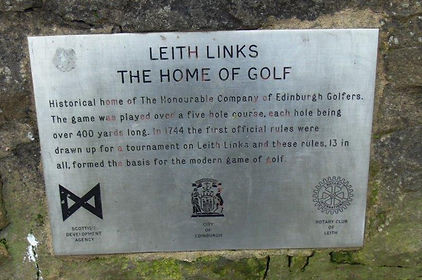
First Written Rules of Golf
Leith Links is where the first rules of golf where written in 1744 for a golf tournament, 13 rules in all. There had only been 5 rules players had played to before. The oldest golf course to be mentioned in history is in fact Bruntsfield Links with the oldest golf club house the Golf Tavern. Which is where the Honourable Company of Edinburgh Golfers were first based as were the oldest golfing society the Burghers (Royal Burgess Golfing Society) incorporated in 1735. Leith Links course has the honour of the first official tournament to rules.
Giants’ Brae
Leith Links Edinburgh
The are two small hills on Leith Links which both have names, the one pictured is
“Giant’s Brae” or “Somerset's Battery”, the other being Lady Fyfe’s Brae or Pelham's Battery
these were said to be constructed as artillery mounds dated from 1560 when the siege of Leith took place
